
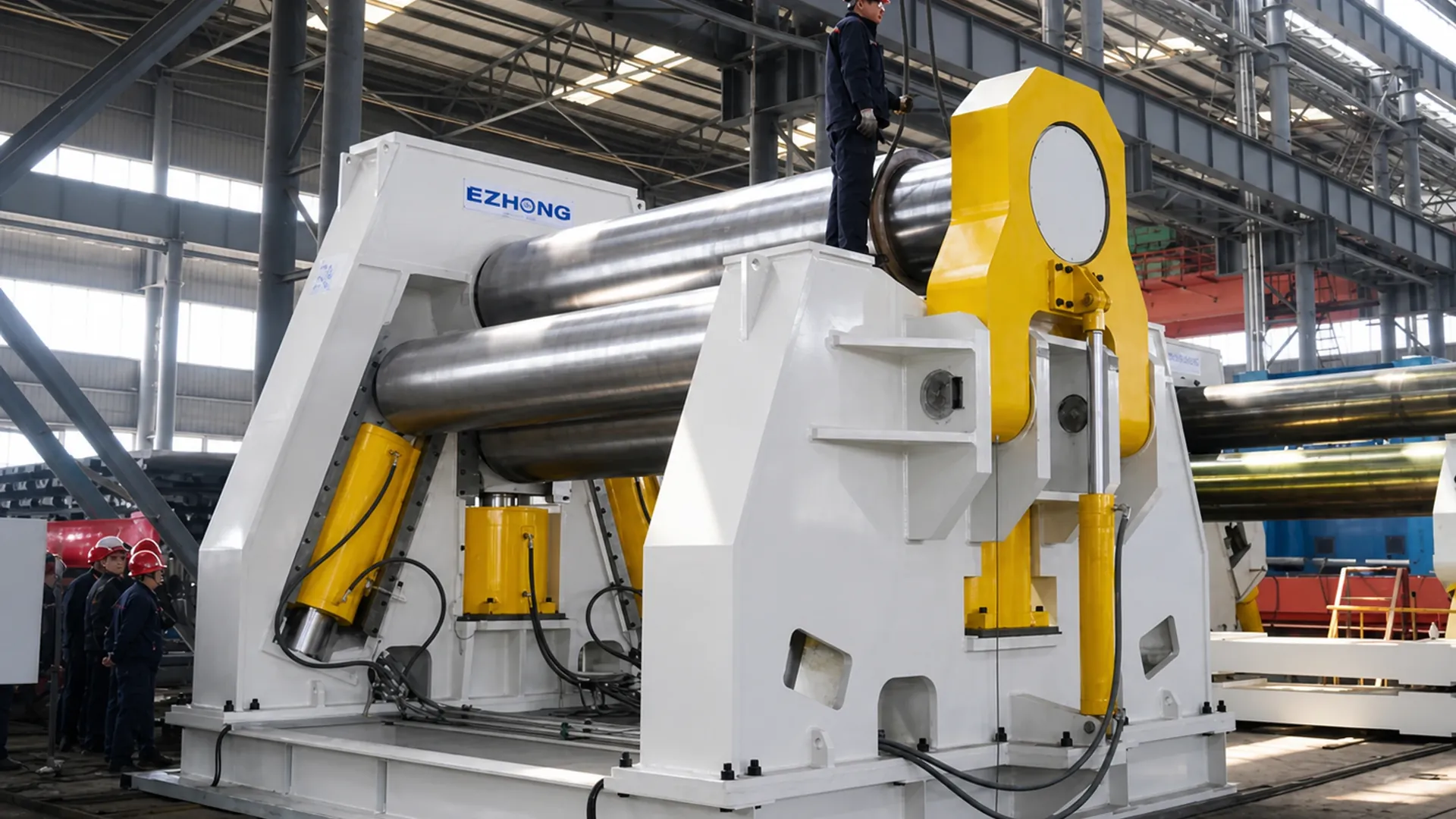
Bending Machine Selection Guide
3-Roll vs 4-Roll Plate Rolling Machines: How to Shortlist the Right Configuration
Compare 3-roll variable-geometry and 4-roll plate bending machines across roll layout, edge pre-bending, plate clamping, catalogue minimum diameters, and handling cycles.
How to Use This Technical Selection Guide
Use this guide to compare machine architectures, organize your workpiece parameters, and prepare structured inquiry specifications for your project. Final machine sizing and tooling feasibility are confirmed by EZHONG engineering based on your submitted drawings and process requirements.
1. Selection Starting Points & Scenarios
Match your primary workpiece types and production volume to candidate machine architectures.
Repetitive shell work with a focus on plate clamping, continuous squaring, and automated feed
Engineering Rationale
Four-roll machines maintain continuous pinching between top and bottom rolls, simplifying plate squaring, pre-bending both ends without plate removal, and rolling in a continuous sequence.
Next Step to Confirm
Confirm batch sizes, crane/handling arrangement, operator skill, and actual cycle time expectations.
Wide variation in plate thickness and target diameters, or heavy plate combined with cone rolling
Engineering Rationale
Variable-geometry 3-roll units allow independent horizontal movement of the lower rolls. Increasing center distance creates wider leverage for heavy plate pre-bending; narrowing it accommodates smaller shell diameters.
Next Step to Confirm
Submit material yield strength, minimum inside diameter, cone apex angles, and required straight-end lengths.
Shipyard curved shell plates, asymmetric bulges, or extra-wide plates
Engineering Rationale
Marine work requires multi-row lower backup rolls and high-rigidity upper beams to resist long-span deflection, well beyond standard 3-roll or 4-roll shop geometries.
Next Step to Confirm
Provide shell curve radius diagrams, plate width, camber requirements, and handling crane clearances.
Balancing capital expenditure, operational duty cycle, and handling requirements
Engineering Rationale
In the official catalogue, both EZW11S 3-roll and EZW12X 4-roll lines are heavy-duty electro-hydraulic machines. Sizing should be driven by handling workflow, crane requirements, and daily operating hours rather than assumed machinery price tags.
Next Step to Confirm
Review required daily production hours, positioning precision tolerances, and operator experience.
Diverse production mix involving varying material yield strengths or small shell diameters
Engineering Rationale
Rolling capacity depends simultaneously on material yield strength, plate width, thickness, and rolled shell diameter. A variable-geometry 3-roll provides adjustable lower-roll center distance for leverage on heavy plate, while a 4-roll ensures fast, secure clamping across standard cylinders.
Next Step to Confirm
Provide material specifications (e.g., Q355B, S355JR, SA516 Gr.70) and target inside/outside diameter ranges.
2. Workpiece Conditions to Clarify Upfront
Measure or confirm these geometric dimensions, yield strengths, and handling limits before requesting equipment quotes.
Parameter 01
Material Grade & Yield Strength (MPa)
Nominal yield point (e.g., 235, 355, 460 MPa) and delivery state (normalized, TMCP, quenched & tempered).
Higher yield strength sharply increases required pre-bending force, springback, and deflection compensation requirements.
Parameter 02
Plate Dimensions Spectrum (Thickness × Width × Length)
List maximum thickness, maximum width, and their actual pairings on real jobs (not an artificial composite maximum).
Tabulated configurations cover maximum thickness of 25–200 mm in EZW11S and 16–60 mm in EZW12X (with heavy EZW12 reaching 140 mm). These figures define catalogue reference configurations rather than the absolute physical limits of machinable thickness. Rolling capacity is governed by the combined conditions of thickness, width, yield strength, and target shell diameter.
Parameter 03
Pre-Bending Thickness vs. Nominal Rolling Thickness
Specify maximum thickness requiring edge pre-bending on the machine.
Machines can roll thicker plates without pre-bending than they can pre-bend. True capacity is constrained by edge pre-bending limits.
Parameter 04
Target Shell Inside / Outside Diameters
Minimum rolled shell diameter at maximum plate thickness, and maximum diameter requirements.
Top roll diameter limits the absolute minimum cylinder diameter. Heavy plate at small diameters requires high bending force within tight geometric clearance. Published minimum diameters represent catalogue reference conditions, not unconditioned limits across all grades.
Parameter 05
Cone Angles and Proportions
Included cone angle, large/small end diameters, and plate thickness.
Cone rolling requires work-roll tilting, dedicated cone-stop guide shoes, and process capacity checks based on cone angle and small-end radius (e.g., catalogue reference condition of 30° at 50% rated load).
Parameter 06
Handling, Feeding & Automation Constraints
Overhead crane availability, plate feed tables, side/top shell supports, and desired degree of CNC cycle automation.
Large shells deflect under gravity during rolling; handling peripherals dictate practical cycle time more than roller rotation speed.
3. Practical Comparison Matrix
Compare roll kinematics, edge pre-bending mechanics, plate clamping, minimum diameters, and cycle times across 3-roll and 4-roll architectures.
| Evaluation Dimension | Variable-Geometry 3-Roll (EZW11S) | Hydraulic 4-Roll (EZW12X / EZW12) | Key Procurement Implication |
|---|---|---|---|
| Mechanical Structure & Geometry | Top roll moves vertically; lower rolls move horizontally and independently (catalogue p. 6). Center distance adjusts dynamically to optimize leverage for heavy plate or narrow for smaller diameters. | Fully hydraulic four-roll architecture with top roll, vertical clamping bottom roll, and two side rolls moving along guiding tracks to pre-bend and bend (catalogue p. 15, 17). | Identify structural kinematics before comparing operations. Variable-geometry 3-roll provides adjustable bottom-roll centers; 4-roll maintains dedicated pinch clamping during bending. |
| Pre-Bending & Edge Flat (Straight End) | Pre-bends plate edges by coordinating lower roll horizontal positioning with top roll vertical stroke. Both ends are pre-bent through operator handling sequence. | Both leading and trailing plate edges can be pre-bent using opposing side rolls without rotating the plate 180 degrees. | Both machine families publish separate pre-bending and rolling thickness ratings. Never size either machine using nominal rolling thickness alone. |
| Workpiece Clamping & Feed Control | Center distance adjustment creates stable wedge positioning and traction for heavy plate; thinner plates require operator alignment attention. | Continuous hydraulic vertical clamping between top and bottom pinch rolls secures plate horizontally, preserving squaring and minimizing slippage. | Review operator alignment and feeding workflow. Four-roll simplifies plate squaring for repetitive cylindrical shells. |
| Digital Positioning & Automation | Digital position readouts, multi-axis hydraulic positioning, and electro-hydraulic roll leveling (e.g. ±0.2 mm synchronization on catalogue models). | Three digital roll-position displays on separate mobile control console (catalogue p. 17). Automation levels (CNC, cycle automation) must be confirmed per project. | Digital positioning readouts are standard on heavy catalogue models; determine which specific positioning steps require digital automation vs. manual intervention. |
| Heavy Plate & Variable Diameters | Expanding bottom-roll center distance significantly expands leverage for extra-thick plate bending (up to 200 mm without pre-bending in catalogue table). | Heavy-duty EZW12 configurations support up to 140 mm plate thickness (120 mm pre-bending, 4000 mm diameter) with hydraulic balancing. | For extreme plate thickness or widely diverging diameter jobs, evaluate both variable-geometry 3-roll and heavy 4-roll engineering configurations. |
| Finished Accuracy & Ovality | Roll synchronization accuracy (e.g., ±0.2 mm) ensures roll parallelism, but finished roundness depends on material springback and rolling passes. | Consistent pinch pressure helps reduce edge flat, but final shell tolerance remains subject to plate thickness variation and yield consistency. | Machine positioning accuracy is not equal to finished shell tolerance. State target roundness, straight-end limit, or drawing tolerances in your RFP. |
4. Real Configuration Examples & Parameter Insights
Representative catalogue parameters illustrating how machine dimensions, force, and capacity interact across real workpiece envelopes.
Pre-Bending Capacity Comparison at Identical 30 mm Nominal Thickness
Catalogue Parameter Example
At an identical nominal rolling thickness of 30 mm and 3000 mm working width, the variable-geometry 3-roll EZW11S-30×3000 specifies 20 mm pre-bending thickness, whereas the 4-roll EZW12X-30×3000 specifies 25 mm pre-bending thickness.
Application & Engineering Context
Identical nominal rolling thickness does not imply identical edge pre-bending capability. Edge pre-bending requires substantially higher force than continuous rolling. Compare machines by their published pre-bending thickness limits rather than nominal shell capacities alone.
Heavy-Duty Four-Roll Engineered Configurations (EZW12 Series)
Catalogue Parameter Example
Catalogue page 17 publishes three dedicated heavy-duty configurations: EZW12-85×3200 (85 mm max / 70 mm pre-bend / 2400 mm min. dia. / 110 kW), EZW12-100×3200 (100 mm max / 90 mm pre-bend / 3000 mm min. dia. / 130 kW), and EZW12-140×4000 (140 mm max / 120 mm pre-bend / 4000 mm min. dia. / 160 kW).
Application & Engineering Context
Catalogue minimum diameters (e.g., 2400 mm to 4000 mm) represent catalogue reference values for heavy plate. Diameter capability is constrained by roll barrel stiffness, frame rigidity, and plate yield strength. Final shell minimum diameter must be calculated against your specific workpiece material.
Variable-Geometry Lower Roll Movement & Cone Rolling Capabilities
Catalogue Parameter Example
Catalogue pages 6–10 detail how independent horizontal movement of the lower rolls provides adjustable center distance, expanding leverage for heavy plate pre-bending while narrowing spacing for smaller shell diameters. Cone rolling devices support up to 30° cone angles at 50% rated load under stated catalogue reference conditions.
Application & Engineering Context
Cone rolling significantly increases asymmetrical roll separating force and friction. Cone capabilities must be verified with plate layout drawings and development angles rather than assuming 100% rated machine capacity during cone forming.
5. Common Selection Pitfalls & Practical Rules
Common procurement assumptions that lead to undersized roll drives, barrel roll deflection, or unworkable tight-diameter limits.
Can 3-roll plate bending machines pre-bend plate ends internally?
Catalogue EZW11S variable-geometry 3-roll machines have published pre-bending thickness ratings and perform edge pre-bending internally by adjusting lower roll center distance and elevation.
Specify your drawing or process requirements for allowable straight-end length and verify whether the proposed 3-roll model pre-bends internally.
Are 4-roll bending machines always more accurate than 3-roll machines?
Finished cylinder accuracy is governed by material uniformity, roll deflection compensation, and springback management. A machine sync accuracy of ±0.2 mm indicates roll alignment, not finished workpiece roundness.
Provide workpiece tolerance expectations (ovality, straightness, edge mismatch) and request configuration confirmation.
Are 3-roll plate bending machines always cheaper than 4-roll machines?
A heavy variable-geometry 3-roll machine with independent horizontal roll positioning and multi-axis CNC is a sophisticated, capital-intensive system that can match or exceed a standard 4-roll investment.
Compare total lifecycle investment based on your required plate handling, cycle time, and production volume.
6. Recommended Starting Points & Engineering Checks
Select a baseline configuration based on your primary workpiece, then verify these specific mechanical limits with our engineering team.
Guidance Summary
Start by evaluating a 4-roll configuration if clamping and feed control are priorities for repetitive cylindrical shell production. Shortlist variable-geometry 3-roll machines if your facility processes widely varying plate thicknesses, large diameter swings, or extra-heavy plate.
Shortlisting between 3-roll and 4-roll configurations must be grounded in your specific production flow, workpiece variety, and handling needs, rather than roll count alone.
Key Reasons for This Starting Focus:
- ✓Four-roll continuous clamping minimizes operator alignment errors and speeds up repetitive pre-bending without rotating the plate.
- ✓Variable-geometry 3-roll allows independent adjustment of bottom-roll centers, creating optimal bending leverage across both thin and heavy plates.
- ✓Neither configuration replaces proper crane and handling equipment when rolling large-diameter, thin-wall shells subject to gravity sagging.
Items Requiring Engineering Verification:
- !Confirm effective bending capacity against actual material mill certificates (yield point MPa).
- !Verify minimum rolled diameter for your most critical workpiece against material yield strength.
- !Review edge flat length requirements and pre-bending cycle steps.
- !Assess plate feeding tables, side supports, and top crane supports for cycle ergonomics.
7. RFQ Preparation: Copyable Inquiry Checklist
Assemble your project details using this standardized template. Items marked Unknown can be confirmed during technical review.
RFQ Preparation
Inquiry Specification Checklist
Custom heavy equipment requires thorough engineering verification. You do not need to calculate precise machine force or roll diameters beforehand. Fill in your known workpiece constraints below; items not yet finalized can be marked as Unknown / To be confirmed or supplemented with part drawings.
Plate Rolling Configuration Review
Use this checklist for 3-roll or 4-roll machine evaluation. Workpiece list should separate distinct plate thicknesses and diameters.
Subject: Plate rolling configuration review
Company / Contact / Email:
Application:
Material grade / yield strength (if known):
Plate list (one row per workpiece): thickness × width × length, material
Finished shape: Cylinder / Cone / Other
Finished diameter (state inside or outside diameter):
Cone dimensions or drawing, if applicable:
Pre-bending / allowable straight-end requirement:
Required dimensional tolerances:
Quantity / batch size / size-change frequency:
Handling and crane constraints:
Operator / automation requirements:
Preferred starting point, if any: 3-roll / 4-roll / Please compare
Drawings / material documents available:
Information still unknown (fill Unknown / To be confirmed):
Please review capacity, pre-bending, handling and the proposed configuration.
Have part drawings or complex tolerance specifications? Note key dimensions in your inquiry, or email CAD/PDF files directly to our engineering team following submission.
Open Contact Page with this Template →Verified Project Case Studies
Explore documented industrial deliveries demonstrating how these machine configurations perform under real-world workshop conditions.
Shanghai Zhenhua Heavy Industries (ZPMC)
Marine Plate Rolling Machine: EZW11S-1800T*12000mm
Delivery of an extra-wide 12-meter marine plate rolling machine with multi-row lower backup rolls, demonstrating deflection compensation and asymmetric curve bending for heavy offshore and port hull structures.
Shandong Renni Hybrid Gas
Case About 3 Rolls Bending Machine (8,000-Ton Heavy Shell)
High-tonnage 3-roll plate bending machine project for Shandong Renni Hybrid Gas, with the published project reference stating up to 8,000 tons of upper-roll pressure.
Lamprell (United Arab Emirates)
EZW11SY-200/4500 Heavy Plate Rolling Machine in Wind Towers
EZW11SY-200/4500 heavy plate rolling line supplied for Lamprell's wind-tower production, with published project data covering heavy DH36 plate and large-width shell forming.
8. Explore Relevant Equipment Families
Open the full product pages to review detailed machine construction, standard specifications, and customer case studies.
CNC 3-Roll Plate Bending Machine
Independent horizontal lower-roll adjustment, digital roll leveling with ±0.2 mm synchronization, and heavy shell rolling capabilities.
CNC 4-Roll Plate Bending Machine
Vertical clamping roll with dual pre-bending cycles in a single feed sequence, ideal for high-productivity shell and cone manufacturing.
Ship Plate Bending Machine
Multi-row lower backup rolls and high-rigidity upper beam design for curved ship hull plates and over-wide structural panels.
Next Procurement Step
Send Your Plate List and Drawing for Configuration Review
Our engineering team will cross-check your plate thickness, width, yield strength, and minimum diameter against verified 3-roll and 4-roll configurations.